
Recycling results

VANA has entered into agreements with a wide range of treatment facilities that since October 2025 have ensured the best possible sorting and recycling of the packaging waste. Based on the suppliers' reported recycling results for Q4 2025, VANA can now publish the recycling results for all treated fractions.
With the takeover of the practical handling of the municipalities' collected packaging, VANA is also responsible for ensuring that the packaging is recycled according to the recycling targets set by the EU. Read more about the EU's requirements for actual recycling.
Recycling results by fractions
In the large table below, you can see an overview of the collection fractions and the percentage of, respectively, sorted for recycling, sorted for incineration, as well as the final recycling. The tables in the drop-down menu below show the sorting for recycling as well as VANA's calculations of the final recycling for the individual fractions. The percentages for sorting and recycling are calculated in relation to the total quantity that has been transferred from the municipalities to VANA.

VANA's sorting and actual recycling of cardboard and paper Q4 2025

The municipalities hand over the fractions cardboard and cardboard/paper to VANA. These originate from kerbside collection from households and drop-off schemes at recycling centres.
Losses in the recycling of cardboard and cardboard/paper occur in the form of manual or mechanical sorting-out of sorting errors in the fraction. During sorting it is unavoidable that some paper and cardboard are also lost - e.g. if a whole or part of a load must be discarded due to large amounts of sorting errors.
When cardboard and paper reach the paper mill and enter the pulper, 100% of the quantity is counted as reused. This is despite the fact that there will in reality be a loss of 2–9% in the form of printing ink, paper clips and ordinary sorting errors that are removed in the process.
VANA's sorting and actual recycling of glass and bottles in Q4 2025
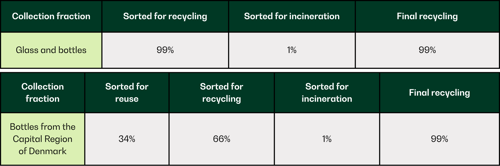
The municipalities transfer the fractions, glass and bottles, to VANA. Bottles come from bring schemes to cubes and recycling centres. Glass originates from collection schemes from households.
Losses in the recycling of glass and bottles occur during the mechanical removal of mis-sorts from the fraction, which are primarily ceramics, porcelain, stone, plastic and paper. When the mis-sorts are ejected, it is unavoidable that some glass is also ejected with them. When glass reaches the glass furnace, 100% of the quantity is counted as reused.
VANA has a requirement for suppliers that the circular recycling, where glass is used for new packaging, must be at least 70%. The remaining recycling can be downcycled for use in e.g. building materials. The circular recycling does not yet appear in VANA's report, but it is expected to be considerably higher for bottles than for glass. The difference is due to the fact that glass, to a much greater extent than bottles, is crushed because of household collection in compactor trucks. This produces many small shards under 1 cm that cannot be recycled into new glass packaging.
Particularly for the Capital Region
VANA directs bottles from the Capital to a sorting plant that can sort out approx. one-third of the volume as whole bottles (primarily wine bottles) for rinsing and reuse. The remaining glass is re-melted into new packaging glass. In addition to one-third of the volume going to reuse, the gentler handling ensures a very high circular recycling rate for the remaining glass because of the low degree of crushing.
VANA's sorting and actual recycling of glass/metal in Q4 2025

Glass/metal primarily originates from kerbside collection schemes from households.
Losses in the recycling of bottles and glass occur in two places. First during the mechanical sorting of the fraction into glass and various metals, where mis-sorts are removed. Afterwards, the glass and metals are further sorted at other sorting facilities. For example, the glass must be separated from ceramics, porcelain and stones before it can be remelted.
When the glass and metals reach the furnace, 100% of the quantity is counted as reused.
VANA's aforementioned requirement to suppliers that the circular recycling of glass must be at least 70% also applies to glass/metal. The circular recycling of glass in glass/metal is lower than for whole bottles, since the glass is crushed to a much greater extent than bottles due to household collection in compactor trucks.
VANA's sorting and actual recycling of metal in Q4 2025

Metal mainly comes from collection schemes from households.
Losses in recycling occur during the mechanical sorting of the fraction, where mis-sorts are rejected.
When the sorted-out metals reach the smelting furnace, 100% of the quantity is counted as recycled.
VANA's sorting and actual recycling of plastic, PFBC and PMFBC in Q4 2025
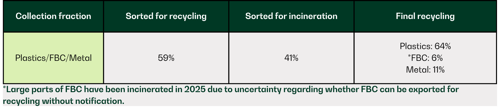
Plastic, PFBC and PMFBC primarily comes from curbside collection schemes from households. Almost all municipalities collect plastic mixed with MDK (PFBC), and some have also included metal in the fraction (PMFBC).
Losses in the recycling of plastic occur in two places. First during the mechanical sorting of the fraction into various plastic types as well as any FBC and metals, where mis-sorts are removed. Afterwards the individual plastic types are further sorted at a number of recycling facilities. For example, sorted-out PE must be re-sorted and washed to remove dirt, other plastic types and mis-sorts. Only when plastic is ready to enter an extrusion or pelletizing process can the quantity be counted as actually reused.
VANA's sorting and actual recycling of FBC in Q4 2025

FBC primarily originates from collection schemes from households. Only four municipalities in Denmark collect clean FBC, and the treatment results for these are shown in the table.
The table above concerns FBC collected separately at households in 4 municipalities. These quantities have, throughout 2025, been allocated to recycling.
Losses in the recycling of FBC occur at the pulping plant, where FBC is added to the pulper so that the paper fibers can be dissolved. When the fibers are extracted from FBC, polyal (the layers of plastic and aluminium in FBC) is left behind together with any mis-sorts. Only a few facilities have the ability to recycle polyal, and VANA's suppliers do not have this option. Polyal therefore goes to incineration, which reduces the recycling rate of the fraction.
Specific to 2025
In 2025 doubts arose from The Danish Environmental Protection Agency (EPA) as to whether FBC can be exported on the green list for recycling. Since no Danish sorting plants have a notification for FBC, the fraction was, at the end of 2025 and the beginning of 2026, primarily allocated to energy recovery. It has now been clarified that FBC can be exported on the green list, and an expert group has been established to contribute to the EPA's preparation of guidance on which purity criteria the fraction must meet.
The unsatisfactory results for the sorting and recycling of FBC in 2025, shown in the section above on Plastic, PFBC and PMFBC, should therefore be seen in light of the unresolved export situation and the resulting need to allocate large quantities to energy recovery. In practice, 100% of the FBC that has been collected separately at households has been sent for recycling, while the same is only true for a very small proportion of FBC collected together with plastic.
How is actual recycling calculated?
The method for calculating the actual recycling for packaging fractions is described in the EU Commission's implementing decision. It describes the calculation points for the individual fractions, i.e. when the material is regarded as recycled. If there is loss or removal of materials before the calculation point, these must therefore be deducted in the calculation of the actual recycling.
